hit the picture and watch the video
Chick here to see the photo gallery from all over the world
Ai Mode
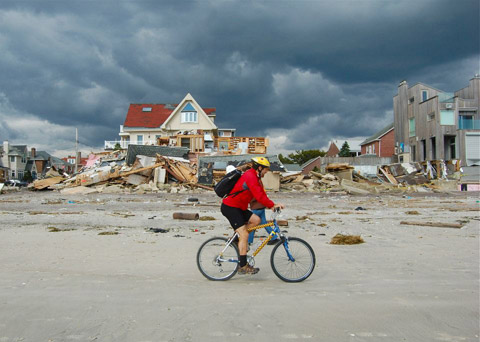
The disaster fundamentally altered the community through several devastating impacts:
- The Storm Surge & Flooding: A historic storm surge completely submerged the peninsula. Ocean water from the south met bay water from the north, trapping residents, flooding intersections, and inundating thousands of homes and businesses under feet of water. [1, 2, 3, 4]
- The Breezy Point Fire: At the western tip of the peninsula in Breezy Point, high winds sparked a massive fire. Because the streets were deeply flooded, firefighters were forced to wade chest-deep through water to reach the blaze. Ultimately, 110 homes burned completely to the ground in one of the most iconic and tragic images of the storm. [1, 2, 3]
- Destruction of the Boardwalk: The famous wooden Rockaway Beach Boardwalk was ripped apart. Miles of heavy timber were lifted off their concrete pilings by the waves and hurled violently into nearby coastal streets and residential properties. [1, 2, 3]
- Infrastructure Collapse: The peninsula was entirely cut off. Power lines sparked and transformers exploded, plunging the entire region into darkness for weeks. The A-train subway line, the primary transit artery connecting the Rockaways to the rest of New York City, suffered severe structural track damage across Jamaica Bay and was knocked out of service for seven months. [1, 2, 3]
From Wikipedia, the free encyclopedia
Hurricane Sandy (unofficially referred to as Superstorm Sandy)[1][2] was an extremely large and devastating tropical cyclone which ravaged the Caribbean and the coastal Mid-Atlantic region of the United States in late October 2012. It was the largest Atlantic hurricane on record as measured by diameter, with tropical-storm-force winds spanning 1,150 miles (1,850 km).[3][4][5] The storm inflicted nearly US$70 billion in damage (equivalent to $98 billion in 2025), and killed 254 people in eight countries, from the Caribbean to Canada.[6][7] The eighteenth named storm, tenth hurricane, and second major hurricane of the 2012 Atlantic hurricane season, Sandy was a Category 3 storm at its peak intensity when it made landfall in Cuba, though most of the damage it caused was after it became a Category 1–equivalent extratropical cyclone off the coast of the Northeastern United States.[8]
Sandy developed from a tropical wave in the western Caribbean Sea on October 22, quickly strengthened, and was upgraded to Tropical Storm Sandy six hours later. Sandy moved slowly northward toward the Greater Antilles and gradually intensified. On October 24, Sandy became a hurricane, made landfall near Kingston, Jamaica, re-emerged a few hours later into the Caribbean Sea and strengthened into a Category 2 hurricane. On October 25, Sandy hit Cuba as a Category 3 hurricane, then weakened to a Category 1 hurricane. Early on October 26, Sandy moved through the Bahamas.[9] On October 27, Sandy briefly weakened to a tropical storm and then strengthened back to a Category 1 hurricane. Early on October 29, Sandy curved west-northwest (the “left turn” or “left hook”) and then[10] moved ashore near Brigantine, New Jersey, just to the northeast of Atlantic City, as a post-tropical cyclone with hurricane-force winds.[8][11] Sandy continued drifting inland for another few days while gradually weakening, until it was absorbed by another approaching extratropical storm on November 2.[8][12]
In Jamaica, winds left 70% of residents without electricity, blew roofs off buildings, killed one person, and caused about $100 million (equivalent to $140 million in 2025) in damage. Sandy’s outer bands brought flooding to Haiti, killing a total of 75 people, causing food shortages, and leaving about 200,000 homeless; the hurricane also caused two deaths in the Dominican Republic. In Puerto Rico, one man was swept away by a swollen river. In Cuba, there was extensive coastal flooding and wind damage inland, destroying some 15,000 homes, killing 11, and causing $2 billion (equivalent to $2.8 billion in 2025) in damage. Sandy caused two deaths and an estimated $700 million (equivalent to $982 million in 2025) in damage in the Bahamas.
In the United States, Hurricane Sandy affected 24 states, including the entire eastern seaboard from Florida to Maine and west across the Appalachian Mountains to Michigan and Wisconsin, with particularly severe damage in New Jersey and New York. Its storm surge hit New York City on October 29, flooding streets, tunnels and subway lines and cutting power in and around the city.[13][14] Damage in the United States amounted to $65 billion (equivalent to $91 billion in 2025).[15] In Canada, two were killed in Ontario, and the storm caused an estimated C$100 million (equivalent to C$135 million in 2025) in damage throughout Ontario and Quebec.[16]